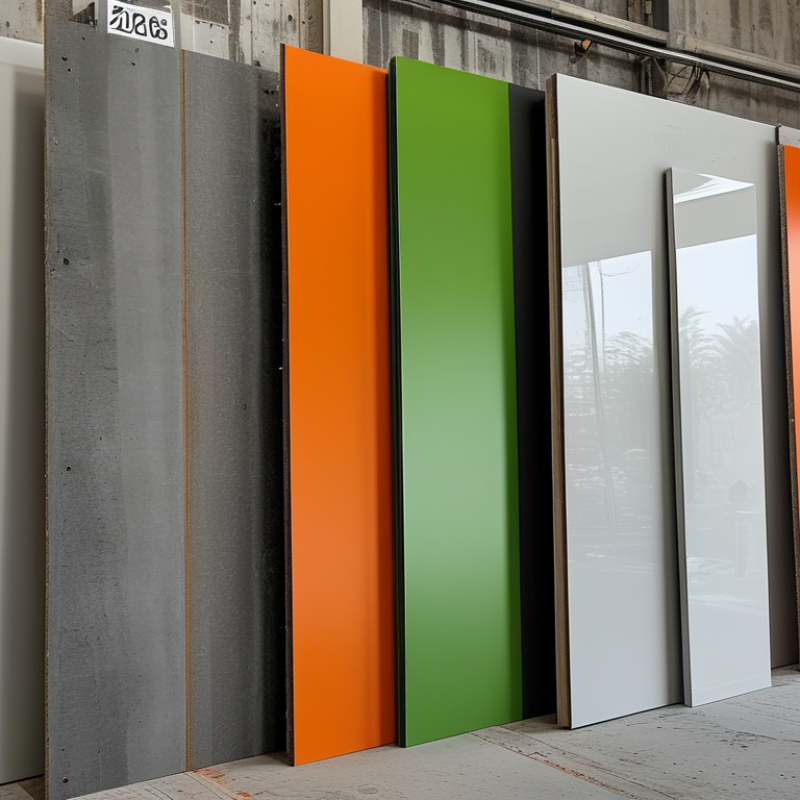
| Project Application | Interior residential, hospitality, office, retail, healthcare, or transport use | Define wall location, occupancy level, cleaning frequency, impact exposure, and whether the panel is decorative or part of a tested wall system | Approved drawings, room schedule, finish schedule, and project specification | Separate requirements by room type; wet areas and public corridors normally require higher moisture and impact resistance |
| Panel Material | Core, surface layer, backing, adhesive, and edge construction | Select from MDF, plywood, mineral fiber, gypsum, PVC, aluminum composite, PET acoustic felt, or wood-plastic composite according to the end-use environment | Technical data sheet, bill of materials, cross-section sample, and independent material test | Request full material disclosure for every layer, including coatings, laminates, inks, and surface treatments |
| Panel Dimensions | Nominal length, width, thickness, squareness, and usable coverage | Specify dimensions in millimetres and define allowable tolerance for each dimension | Caliper, steel rule, diagonal measurement, and dimensional inspection report | Common decorative panel thickness: approximately 5–25 mm; confirm the actual range by material and installation method |
| Dimensional Stability | Resistance to expansion, contraction, bowing, and edge movement | Set maximum length, width, thickness, and warpage variation after humidity conditioning | Conditioned-panel testing under the applicable wood, composite, or polymer-panel standard | For wood-based products, define installation acclimatization and expansion-gap requirements before purchase |
| Surface Finish | Colour, texture, gloss, pattern repeat, scratch resistance, and cleanability | Approve a physical master sample and define colour tolerance, gloss range, texture direction, and repeat length | Visual comparison under controlled lighting, gloss measurement, and surface-resistance testing | Use one retained reference sample for production approval, shipment inspection, and future reorders |
| Fire Performance | Reaction to fire, flame spread, smoke development, and—where required—fire resistance of the complete wall assembly | Specify the destination-market classification, such as EN 13501-1 or ASTM E84; do not treat a decorative-panel rating as a wall-assembly fire-resistance rating | Review a current laboratory report identifying the exact panel construction, thickness, coating, and mounting method | Fire classifications are system- and test-configuration-specific; generic certificates should not be accepted without construction matching |
| Formaldehyde and VOCs | Indoor-air emissions from wood-based cores, adhesives, coatings, and backing materials | Define the destination-market emission limit and require testing for the finished panel, not only the raw board | Laboratory chamber testing such as EN 717-1 or applicable North American composite-wood requirements | For U.S. composite-wood products, verify the applicable TSCA Title VI emission category; limits differ by panel type |
| Moisture Resistance | Suitability for bathrooms, kitchens, humid climates, and occasional splash exposure | State whether the product is dry-area, humid-area, or wet-area suitable; define water absorption, swelling, and edge-sealing requirements | Water-immersion or humidity-cycle test relevant to the panel material, plus inspection of sealed edges | Do not describe a panel as waterproof unless the complete panel, joints, backing, and installation system have been tested |
| Acoustic Performance | Sound absorption or sound insulation objective | Define whether the target is absorption, reverberation control, or airborne sound insulation; specify the required mounting cavity and backing | Laboratory test using the applicable ISO 354, ASTM C423, or project-standard method | Acoustic values change significantly with air gaps, insulation, joints, and mounting; compare reports only when test setups match |
| Mechanical Performance | Impact resistance, screw holding, pull-off strength, abrasion, and edge durability | Set performance levels according to traffic, furniture contact, maintenance equipment, and installation hardware | Material-specific mechanical tests, installation pull tests, and sample impact testing | High-traffic public areas require stricter impact and cleanability criteria than low-traffic residential rooms |
| Installation System | Direct adhesive, mechanical clips, concealed fasteners, battens, or demountable framing | Define substrate tolerance, joint width, corner detail, access panels, trims, adhesives, and required tools | Full-size installation mock-up and written installation method statement | Order 5–10% additional panels for cutting and damage allowance, subject to layout complexity |
| Sustainability Documentation | Recycled content, responsibly sourced fibre, recyclability, life-cycle data, and packaging materials | Request percentage-by-weight recycled content, chain-of-custody evidence where applicable, EPD availability, and packaging composition | Certificate verification, bill-of-material review, and independent sustainability-document check | Environmental claims must identify the product scope, calculation method, validity period, and certification body |
| Packaging and Protection | Protection against moisture, abrasion, corner damage, contamination, and pallet deformation | Use protective film where appropriate, rigid corner protection, moisture barriers, pallet identification, and vertical/horizontal stacking instructions | Packaging drop or vibration assessment, loading photographs, and pre-shipment inspection | Record net weight, gross weight, package dimensions, pallet count, and cubic volume for freight planning |
| Minimum Order Quantity | Minimum order for standard, custom-colour, custom-size, and custom-pattern products | Separate sample quantity, pilot quantity, first production order, and repeat-order quantity | Written quotation with MOQ by finish, size, colour, packaging format, and tooling requirement | Indicative planning range: samples 1–10 panels; pilot orders 50–300 panels; production MOQ varies by material and customization |
| Lead Time | Sample development, approval, production, inspection, and export preparation | Create separate milestones for technical approval, colour approval, production release, inspection, and dispatch | Supplier production schedule and dated order-confirmation document | Indicative planning range: stock items 2–4 weeks; customized production 4–10 weeks; add transit and customs time |
| Shipping and Trade Data | Delivery term, export packing, customs classification, country of origin, and shipment volume | Agree the Incoterm, port or delivery point, HS classification, carton marks, documents, and responsibility for customs clearance | Commercial invoice, packing list, transport document, origin documentation, and customs broker review | Compare landed cost per square metre, not only factory price; include freight, insurance, duty, brokerage, inland delivery, and inspection |
| Quality Control Plan | Inspection level, defect classification, sampling quantity, and acceptance criteria | Define checks for dimensions, colour, surface defects, warpage, packaging, labels, quantity, and documentation | Pre-production sample, during-production inspection, and pre-shipment inspection against an approved golden sample | Use an agreed sampling plan; critical safety or compliance defects should have zero acceptance tolerance |
| Warranty and After-Sales Support | Coverage for delamination, colour variation, cracking, warping, coating failure, and replacement parts | Define warranty duration, exclusions, claim evidence, replacement procedure, spare-panel ratio, and response time | Signed warranty terms and documented corrective-action process | Maintain spare stock for discontinued finishes and record batch or lot numbers for traceability |
| Total Cost of Ownership | Purchase price, accessories, installation, freight, duty, waste, maintenance, and replacement cost | Compare suppliers using an identical cost model based on delivered and installed cost per square metre | Bid comparison sheet, freight quotation, installation estimate, and maintenance schedule | Recommended comparison formula: landed product cost + accessories + installation + expected waste + maintenance allowance |